

Rhinoplasty
How to Plan Rhinoplasty Travel from Oman: A Practical Guide
A rhinoplasty travel checklist from Oman to Iran covering case review, surgeon and hospital checks, quotes, travel documents, and follow-up.
If you live in Oman and are considering rhinoplasty travel to Iran, plan the journey before you book flights or pay deposits. The safest early step is to separate what you want from what only a qualified surgeon can assess, then build a written plan that covers clinical review, facility checks, a patient-specific quote, travel documents, and return follow-up. Marketing pages and social media posts are not a substitute for that work.
People often start from a price screenshot or a friend's story. Those fragments can motivate a conversation, but they are not a plan. A usable plan answers who decides what, what information is still missing, and what must be true on paper before money or tickets move.
This cornerstone guide walks through a practical sequence you can reuse. It is written for coordination and decision hygiene, not for clinical advice. Where general medical organizations publish public education on rhinoplasty, we paraphrase those themes and keep individual conclusions with your treating team. For Aysara's Rhinoplasty travel page, see the Rhinoplasty coordination page.
Clarify appearance goals, breathing concerns, or both
Start with plain language about your own goals. Some people are mainly concerned with appearance. Others are mainly concerned with nasal breathing or prior injury. Many have elements of both. Naming the goal helps you ask clearer questions later, but it does not decide whether surgery is appropriate.
Public educational materials from organizations such as the NHS and the American Society of Plastic Surgeons describe rhinoplasty as surgery that can change the shape of the nose and, in some cases, may relate to breathing problems when a clinician judges that to be relevant. Those overviews also stress assessment, realistic expectations, and risk discussion. They do not let a website declare that you need surgery, that breathing will improve, or that a cosmetic request automatically includes functional work.
Write your goals in one short paragraph you can reuse in every conversation. Separate "what I hope to change" from "what I need a clinician to evaluate." That habit reduces mixed messages when a coordinator, hospital desk, and surgeon each ask similar questions in different order.
Leave candidacy, technique choice, and the boundary between cosmetic and functional scope to a qualified surgeon after history and examination. If breathing is part of your concern, expect the clinician to ask about symptoms, prior trauma or surgery, medications, and possibly further tests. Do not self-diagnose septal deviation or treat online checklists as a substitute for assessment.
Separate surgeon, hospital, coordinator, and patient roles
Cross-border medical travel goes wrong when one person is assumed to own every decision. Write the roles down early so messages, payments, and escalations stay clear.

- Treating surgeon: assesses suitability, proposes scope, explains risks and alternatives, obtains clinical consent, and directs operative and clinical aftercare decisions.
- Hospital or international patient department: manages facility processes, admission and discharge logistics, and the hospital side of quotation and records according to its own rules.
- Aysara coordinator: helps with non-clinical sequencing such as communication, travel timing, accommodation planning, and keeping documents organized. Aysara does not replace the clinician.
- Patient (and companion, if any): provides full history, verifies documents, confirms quote inclusions in writing, keeps copies of key papers, and asks for clarification before paying or flying.
If a message blurs these roles, pause and ask who owns the decision. A coordinator can help you prepare questions. Only the clinical team can answer medical ones.
Gather accurate information for case review
Before a serious remote or in-person review, assemble a complete, honest packet. Incomplete history is a common reason for delayed quotes, changed plans, or unsafe assumptions. Include what you know about previous nasal surgery or trauma, current medications and allergies, smoking or nicotine use, bleeding or healing concerns, chronic conditions, and any recent imaging or specialist letters you already have.
Organize the packet so each item has a date and a source. If you do not have a record, say so plainly instead of guessing. Coordinators can help you label files and keep versions straight. They cannot invent clinical facts you did not provide.
Be precise about your goals and about what would count as an unacceptable trade-off for you. Photographs can help communication when a clinician requests them, but photos are not a diagnosis and should not be treated as a promise of a result. Do not send unnecessary medical documents through informal first-contact channels if a secure pathway has been defined for clinical review.
Aysara's first hospital partner programme uses Nikan's confirmed international-patient service package as a planning catalogue. Rhinoplasty appears there under cosmetic surgery for prioritization and general content. Catalogue presence supports planning conversations. It does not create a named surgeon assignment, a fixed patient price, or a guarantee of technique, stay length, or outcome for your case.
Verify surgeon, facility, scope, risks, recovery, and alternatives
Treat verification as a checklist, not as a popularity contest. Ask who will assess you, who will perform each part of the procedure, and what licence or hospital privileges support that work in the relevant jurisdiction. Ask how the facility handles anesthesia, emergencies, infection-control processes, admission, and discharge documentation.
Public surgeon-selection guidance from professional societies commonly urges patients to confirm training, experience with similar cases, and clear discussion of complications and revision policy. Use those themes as questions, not as a ranking of Iranian credentials that you invent from foreign board names. Foreign certification examples explain principles. They are not automatic proof of an individual surgeon's local registration.
Ask what is included in the proposed clinical scope and what is explicitly out of scope. If breathing is part of the discussion, ask whether functional assessment is planned and how that would change the quote if added later. Ask about expected recovery milestones in general terms, knowing that your own timeline depends on clinical judgment. Ask what alternatives exist, including waiting, non-surgical options where relevant, or declining surgery.
Store answers in one place with the date you received them. If two people give conflicting answers, ask for a single written clarification before you proceed. Ambiguity is cheaper to resolve on email than after a deposit.
Refuse pressure language such as "best", "risk-free", "scarless", guaranteed breathing improvement, or outcome percentages. Serious planning tolerates uncertainty and puts residual risk in writing.
Obtain a patient-specific quote you can audit
A catalogue range is a planning signal for hospitals and coordinators. It is not your personal total. Ask for a written quote that states inclusions, exclusions, validity dates, currency, and what happens if scope changes after examination. Clarify who pays for extra nights, medicines, consumables, tests, companion lodging, airport transfers, and revision-related costs if they arise.
Confirm which parts of the quote are clinical facility items and which parts are travel or coordination items. Keep versions dated. If two or three clinician fee options are offered within a hospital process, compare them on credentials and communication quality as well as price. Do not choose by price alone.
Ask what contingency ownership looks like if imaging, anesthesia assessment, or inpatient needs change after arrival. A quote that cannot explain change handling is incomplete for cross-border planning, even if the first number looks tidy.
Build a rhinoplasty travel checklist from Oman
Travel rules, entry requirements, insurance products, and safety advice change. Before you lock tickets, verify current guidance for your own nationality and residency status. Oman's Foreign Ministry publishes travel advice for Omani citizens and residents; use the live advisory for your trip dates rather than copying an old summary from a blog.
Build a simple timeline with buffers. Remote case review, quote confirmation, passport checks, insurance purchase, accommodation holds, and companion arrangements rarely finish on the same day. Rushing the logistics usually creates the pressure that leads to incomplete paperwork.
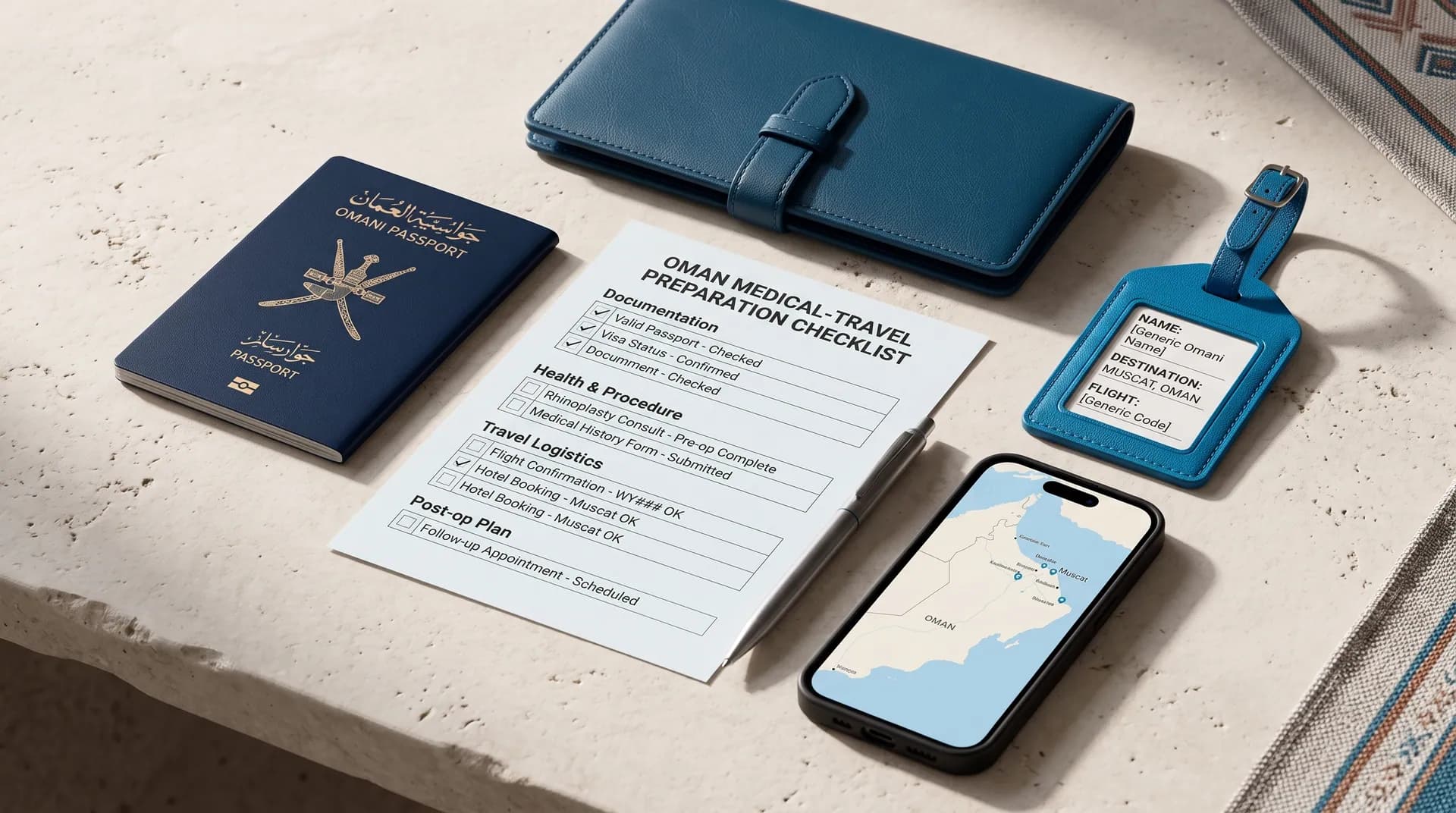
- Passport validity and any required entry documents for your itinerary.
- Travel insurance that you have read for medical and trip-disruption terms; confirm what it excludes.
- Medication list, packing plan, and a copy of key clinical summaries in a form your clinicians accept.
- Accommodation near the facility for the expected stay window, with flexibility if discharge timing shifts.
- Flexible return options where practical, plus a companion plan if you may need support after discharge.
- Emergency contacts in Iran and in Oman, including who to call for logistics versus clinical escalation.
Do not treat any article, including this one, as a permanent statement of visa, flight, insurance, or security conditions. Re-check close to departure.
Clarify discharge, fitness to fly, and Oman-side follow-up
A complete plan includes the return, not only the arrival. Ask who decides fitness to fly and what written discharge instructions you should receive. Ask how complications are handled after you leave the hospital and after you return to Oman. Confirm who owns escalation: the treating team, a local clinician you already know, emergency services, or a sequenced contact path.

Professional recovery education commonly notes that swelling and healing continue over time and that instructions from your own surgeon govern activity, wound care, and follow-up timing. Cross-border travel adds logistics on top of that clinical advice. Book your return only after the clinical team has explained the constraints for your case.
Decide in advance where discharge papers, medication lists, and follow-up contacts will live after you return to Oman. A shared folder with your companion, if you have one, reduces lost messages when you are tired. Keep clinical questions on the clinical channel and logistics questions on the coordinator channel.
Pre-booking checklist and calm next step
Before you pay a deposit or buy non-refundable tickets, confirm the following in writing where possible:
- Your goals are written plainly, and you understand that suitability is a clinical decision.
- Roles for surgeon, hospital, coordinator, and patient are clear.
- Case-review information is complete and accurate.
- Surgeon and facility verification questions have answers you can store.
- The quote lists inclusions, exclusions, validity, and change rules.
- Travel, insurance, accommodation, companion, and emergency contacts are current for your dates.
- Discharge, fitness-to-fly, and Oman follow-up ownership are named.
If any item is missing, slow down. A calm delay is usually cheaper than an unclear booking. When you are ready for coordination help, start with a short non-clinical message and keep medical documents on the pathway your clinical review process specifies. Use the Rhinoplasty coordination page for the service overview, then continue only when the written plan is coherent.
Sources
- Nikan IPD Service Package 2025-2026 (provider catalogue evidence)
- Oman Foreign Ministry: travel advice for Omani citizens and residents
- NHS: nose reshaping (rhinoplasty) overview
- American Society of Plastic Surgeons: rhinoplasty overview
- American Society of Plastic Surgeons: rhinoplasty candidates
- American Society of Plastic Surgeons: rhinoplasty consultation
- American Society of Plastic Surgeons: rhinoplasty risks and safety
- American Society of Plastic Surgeons: choosing a surgeon
- American Society of Plastic Surgeons: rhinoplasty cost factors
- CDC: medical tourism
Related articles

Rhinoplasty
Am I a Candidate for Rhinoplasty? What a Surgeon Assesses
What a rhinoplasty candidacy assessment covers, what a surgeon checks, and why suitability requires history, examination, and any needed tests.

Rhinoplasty
How to Choose a Rhinoplasty Surgeon and Hospital
How to choose a rhinoplasty surgeon and hospital using questions about training, licensing, facility safety, complications, and follow-up, not price alone.

Rhinoplasty
Rhinoplasty Consultation: Questions to Ask Before You Decide
A rhinoplasty consultation checklist covering candidacy, risks, consent, recovery, travel follow-up, and the itemized quote.
Need help planning a trip?
Start with a short message by phone, email, or WhatsApp. Do not send medical documents through the first-contact form.