

Rhinoplasty
Rhinoplasty Swelling: When Will the Final Result Show?
When does swelling go down after rhinoplasty? Learn why it changes in stages, why the tip may take longer, and when to ask your surgeon.
If your nose still looks unfamiliar after rhinoplasty, the short answer is that early appearance is not the same as the settled result. Swelling resolves in stages, the tip often changes more slowly than the bridge, and subtle refinement can continue for a year or longer. A nose at three months is not automatically the final result, but that sentence also cannot be used to dismiss a concern about your own nose. A concern belongs with the treating team.
The hard part is that healing is visible while it is still unfinished. One morning can look different from the previous evening. One side may seem fuller, the tip may look broad, or a small irregularity may draw your attention. These observations are reasons to record and ask, not evidence that the operation has succeeded or failed. For the wider recovery sequence, read Rhinoplasty recovery, week by week. For the full Oman-to-Iran planning sequence, use How to plan rhinoplasty travel from Oman.
Why the nose swells
Surgery temporarily changes tissues and the small spaces around them. The body responds with inflammation and fluid movement as healing begins. The amount and location of swelling depend on the operation, the tissues involved, the person's healing response, and the instructions given by the treating team. Swelling is not a simple readout of the final shape, and an image cannot separate healing from a problem.
The stages of change, without a promise
In the earliest stage, swelling and bruising are usually the most obvious. Dressings, congestion, stiffness, and reduced sensation can make the face feel unlike itself. The outside appearance during this period is affected by both the operation and the protective materials around it. The first weeks are for following the team's plan and attending the reviews they set, not for judging the final contour.
Over the following months, the visible swelling generally becomes less prominent, but change is not necessarily linear. It can fluctuate from day to day or appear more noticeable at one time of day. The bridge and sides may seem to settle before the tip. This is a general description, not permission to ignore pain, fever, bleeding, breathing difficulty, or any unexpected symptom. Ask the treating team what applies to you.

Later, smaller changes can continue while the tissues refine. Professional patient education from the NHS and the American Society of Plastic Surgeons describes a recovery in which initial swelling settles over the early period, while the nasal contour may continue to refine over many months and up to a year. Some patients may take longer. There is no universal month at which an online article can declare every nose finished.
Skin thickness changes the pace of what you see
The skin covering the nose is part of the healing picture. Thicker skin and the tissues beneath it can make fine structural changes less immediately visible and can make the tip look fuller for longer. That does not let a reader diagnose their own skin type from a mirror, and it does not predict what their nose can achieve. It means the surgeon has to assess the skin and underlying structure together when setting expectations. The thick-skin article in this series discusses that planning factor separately.
A patient should not hear "thick skin" as a judgement or a verdict. It is a planning description, not a measure of worth and not a promise of a poor result. The important question is what the treating surgeon sees on examination, what the proposed plan includes, and what degree of change can be discussed honestly for that individual case.
Why the two sides can look uneven while healing
Swelling does not always appear evenly on both sides. The operation may affect each area differently, and the tissues may respond at different speeds. Light, camera angle, head position, facial expression, and a small change in the way the tip is viewed can also exaggerate a difference in a photograph or mirror. That does not prove that an asymmetry is harmless, and it does not prove that it is a complication. The treating surgeon is the person who can examine it and place it in context.
Contact the team if an appearance concern is persistent, worsening, or simply worrying you. Bring the question without trying to label it first. A useful message says what changed, when you noticed it, whether symptoms changed with it, and what the team has already told you. Do not press, massage, tape, inject, or otherwise alter the nose unless your treating team has directed you to do so.
How to take photographs that help a review
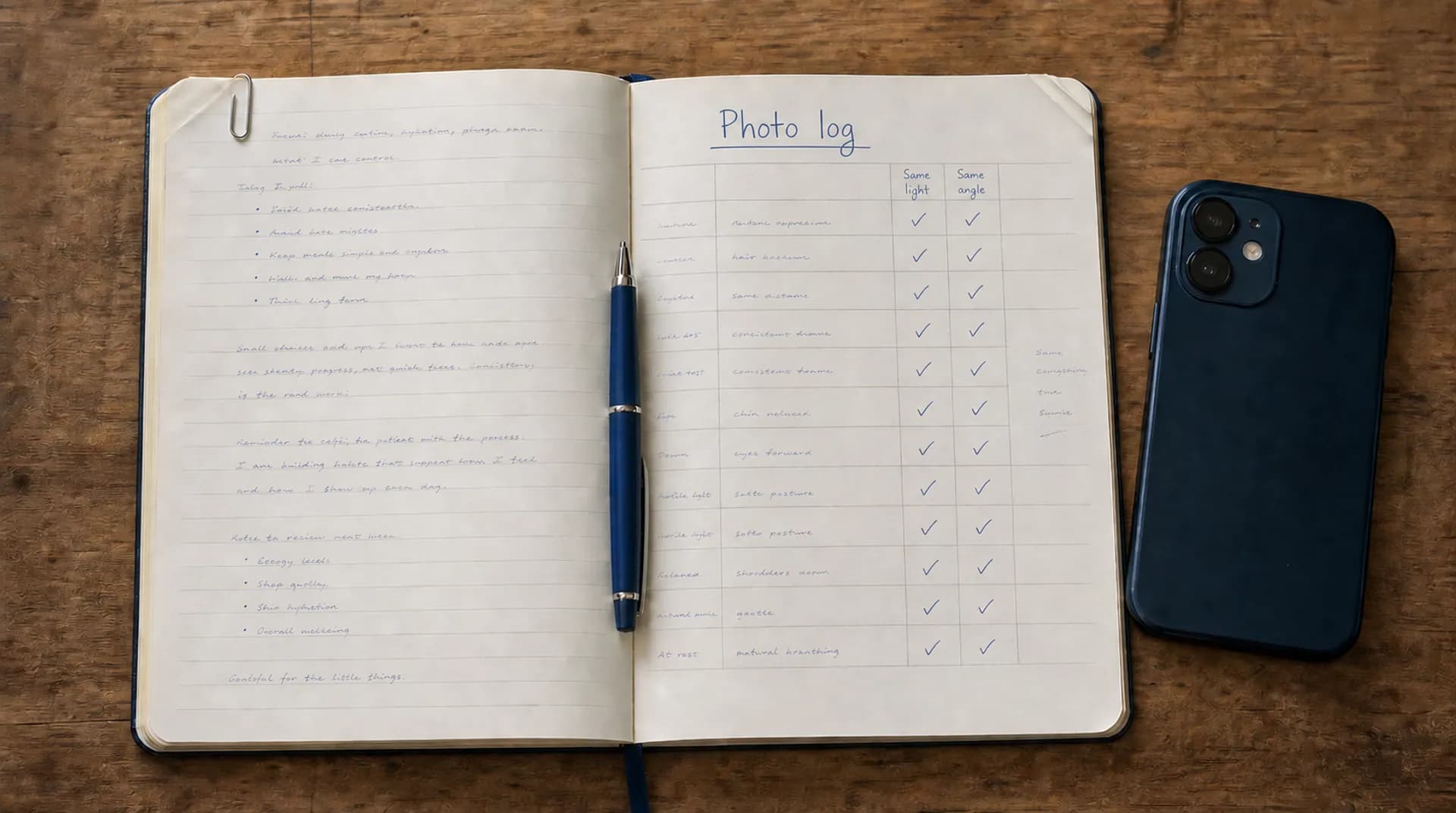
Daily photographs taken in different rooms and light can make a slow process look like a series of unrelated results. If the treating team asks for images, follow its instructions. When it has not specified a format, ask before sending. Useful principles may include the same light, the same distance, the same angle, a neutral expression, no beauty filter, and no digital alteration. The aim is to help the clinician compare information, not to create a perfect-looking sequence.
- Keep the original file and note when it was taken without adding a date or claim to the image itself.
- Use the same camera position and lighting when the team asks for comparison images.
- Do not crop away the context that helps the clinician understand the view.
- Do not use a filter, reshaping tool, or computer simulation as evidence of healing.
- Send images through the secure or agreed clinical route, not a public post or an unnecessary group chat.
Photographs are communication material. They are not a substitute for examination, and they should not be used to seek a diagnosis from a coordinator. If the team needs to see you in person or requests another form of review, follow that instruction.
When a shape concern becomes a revision conversation
A conversation about revision is usually not opened by a single early photograph. The surgeon first needs to understand healing, examine the tissues, hear the patient's concern, and decide whether a concern is still changing or needs another response. The timing is case-specific. Swelling can obscure the contour, so rushing to a revision conclusion during early healing can create a second decision on incomplete information.
This does not mean every later concern will be solved by waiting. It means the conversation should happen with the treating surgeon, at a time and in a form that allows a proper assessment. The primary and revision rhinoplasty article in this series explains those different planning situations. It will not turn a general timeline into a recommendation for your case.
If you are worried after returning to Oman
Before leaving Tehran, keep the discharge papers, medicines, restrictions, follow-up plan, and agreed contact route together. Ask who decides whether a new symptom needs same-day review and what to do outside clinic hours. After you return to Oman, send clinical questions to the treating team through the agreed route. Aysara can help organise non-clinical communication and pass a logistics question to the relevant contact, but it does not diagnose a photograph or overrule the surgeon.
For a sudden or serious emergency in Oman, use local emergency services. Do not wait for a coordinator to interpret a symptom that may need urgent care. For a non-urgent appearance concern, send a concise record: what you noticed, when it changed, any associated symptoms, the photographs requested by the team, and the question you want answered. Clear information helps the clinical team decide the next step.
For the recovery sequence, see Rhinoplasty recovery, week by week. For the instrument question, read Piezo ultrasonic rhinoplasty: what the technique changes. For the planning foundation, use How to plan rhinoplasty travel from Oman. Aysara's role is described on the Rhinoplasty coordination page.
A patient answer, without a false reassurance
Swelling can make an early nose look unlike its later form, and the tip may be the slowest area to refine. That is why patience is part of the plan. But patience is not a diagnosis. If your own appearance or symptoms worry you, ask the treating team for an examination or the review it recommends. The safest useful answer is the one tied to your case, not a promise borrowed from someone else's timeline.
Sources
- NHS: nose reshaping (rhinoplasty) overview (accessed 2026-08-31)
- American Society of Plastic Surgeons: rhinoplasty recovery (accessed 2026-08-31)
- American Society of Plastic Surgeons: rhinoplasty procedure (accessed 2026-08-31)
- ENT Health: rhinoplasty patient FAQs (accessed 2026-08-31)
- Dr. Sara Arjang provider archive: rhinoplasty aftercare and expectation pages (retrieved 2026-08-23, structure and patient questions only)
Related articles

Rhinoplasty
How to Plan Rhinoplasty Travel from Oman: A Practical Guide
A rhinoplasty travel checklist from Oman to Iran covering case review, surgeon and hospital checks, quotes, travel documents, and follow-up.

Rhinoplasty
Rhinoplasty Recovery, Week by Week
Rhinoplasty recovery timeline: what may change from the first week through the first year, and which questions belong with your treating surgeon.

Rhinoplasty
Thick-Skin Rhinoplasty: What a Fleshy Nose Means for Planning
What thick skin and a fleshy nose can mean for rhinoplasty planning, healing, realistic expectations, and a surgeon's assessment.
Need help planning a trip?
Start with a short message by phone, email, or WhatsApp. Do not send medical documents through the first-contact form.