

Rhinoplasty
Rhinoplasty and Breathing: What Needs Clinical Assessment?
How to separate cosmetic goals from breathing concerns, prepare a useful symptom history, and discuss functional assessment with a treating clinician.
People often use the word rhinoplasty to describe more than one goal. Someone may want a change in appearance and also report a blocked nose, mouth breathing, poor sleep, reduced exercise tolerance, or a change after an injury. Those concerns should be stated clearly in the consultation. They cannot be safely converted into a diagnosis by a blog post, an image, or a promise that a cosmetic change will solve them.
Appearance and breathing are related, but they are not the same question
Rhinoplasty is commonly discussed as a procedure that changes the external shape or proportions of the nose. A functional assessment asks a different set of questions: how air moves, when obstruction occurs, whether the problem is on one side or both, and whether another condition could be contributing. A person can have a cosmetic concern without a breathing problem, a breathing problem without wanting a cosmetic change, or both at once.
The American Society of Plastic Surgeons describes septorhinoplasty as combining septoplasty, which addresses the septum, with rhinoplasty, which changes the shape of the nose. That explanation is educational, not a recommendation that the procedures should be combined for every patient. The need for any functional procedure must be assessed by the treating clinician and must not be assumed from a cosmetic consultation.
Describe the breathing problem precisely
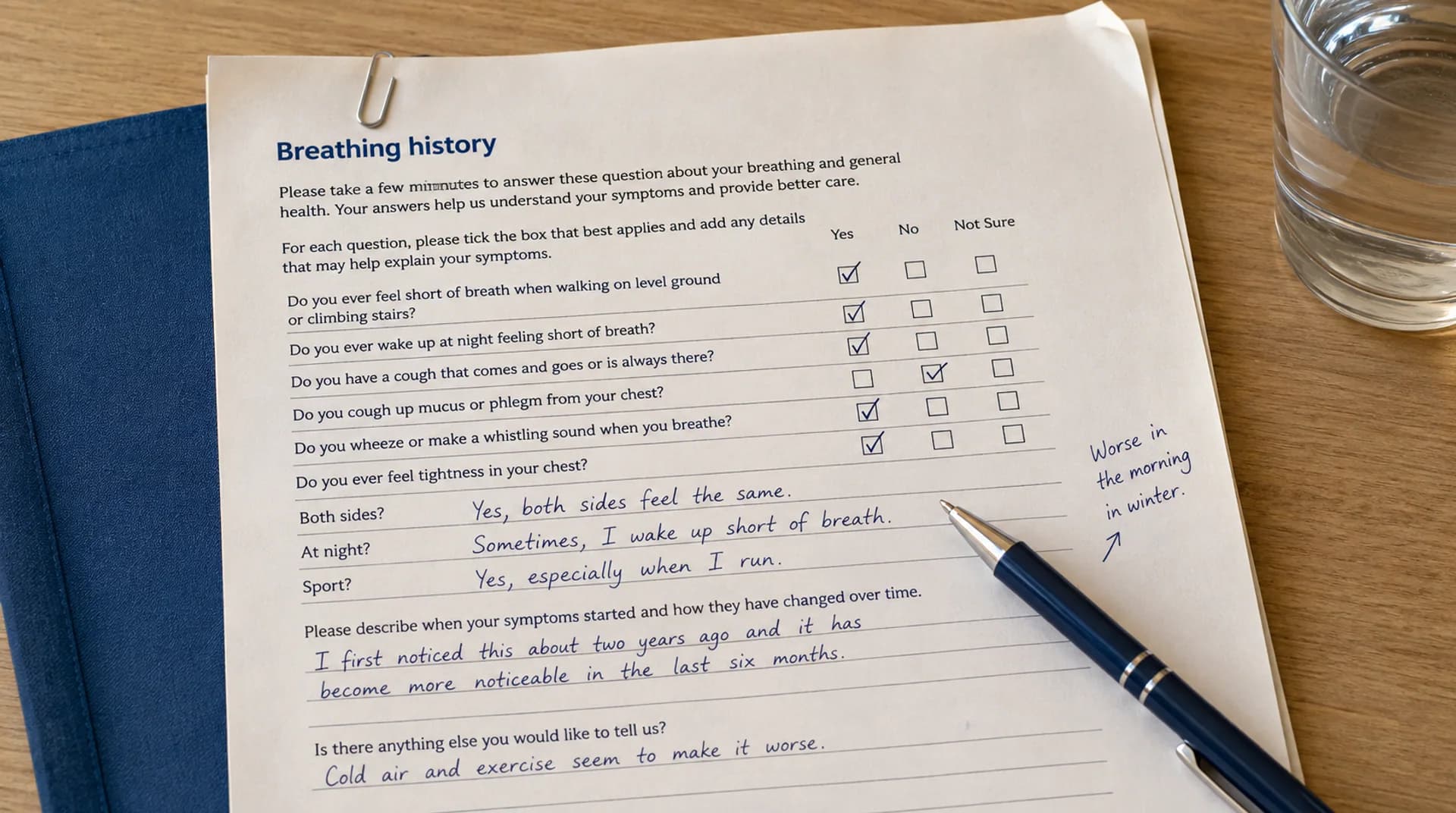
Before an appointment, write down what you feel and when it happens. A useful history is more detailed than saying that your nose is blocked. It gives the clinician a pattern to investigate and helps separate a long-standing concern from a recent change.
- Is the difficulty on one side, both sides, or does it alternate?
- When did it begin, and has it changed after an injury, infection, or previous operation?
- Is it worse at night, during sleep, with exercise, in a dusty place, or in a particular season?
- Do you breathe through your mouth, snore, wake with a dry mouth, or notice a change in smell?
- Do allergies, colds, sinus symptoms, medicines, or a known health condition affect it?
- What have you already tried, and what happened when you tried it?
- Is there pain, bleeding, discharge, fever, or a sudden change that needs prompt attention?
Do not stop a prescribed medicine or start a nasal spray because a general article mentions it. Tell the clinician what you use, including non-prescription medicines and supplements, and ask what applies to your history. If the problem is new, severe, or rapidly worsening, seek appropriate medical advice instead of waiting for a cosmetic consultation.
What a clinician may need to assess
The assessment starts with your symptoms and medical history. The clinician may examine the outside and inside of the nose and consider the septum, the nasal valves, the turbinates, the lining of the nose, and other causes that fit the history. A professional clinical guideline recommends assessing nasal airway obstruction during the preoperative evaluation, but the exact examination and any further tests, endoscopy, photographs, or imaging depend on the patient.
A visible nose shape does not reveal the whole nasal airway. A nose that looks straight can still feel obstructed, and a nose that looks uneven may not be the cause of a breathing complaint. This is why a clinician should ask questions and examine you rather than infer function from a front-facing photograph.
- Your breathing history and the timing of the symptoms.
- Previous nasal injury, surgery, infection, allergy, or airway treatment.
- The internal and external structures that may affect airflow.
- Your cosmetic goals, if you have them, kept separate from the question of function.
- The likely alternatives, limits, risks, and follow-up for any proposed plan.

Do not assume cosmetic rhinoplasty will improve breathing
It is possible for an operation to address both appearance and function in a carefully assessed case, but that possibility is not a promise. Cosmetic rhinoplasty may not address the cause of obstruction, and a functional problem may require a different evaluation or procedure. Even when a functional goal is part of the plan, the clinician should explain the expected benefit, the limitations, the alternatives, and the possibility that symptoms may persist.
Do not choose a provider or package because it uses the phrase breathing improvement without describing the assessment behind it. Ask which clinician is responsible for the functional evaluation, what has been found, what procedure is being considered, and which part of the plan is included or excluded. The clinical decision belongs to the treating team, not to a travel coordinator or a landing page.
Questions for a consultation about breathing
- What could be causing my breathing difficulty based on my history and examination?
- Is the concern related to the septum, nasal valves, turbinates, allergies, the nasal lining, or another factor?
- What examination or test is needed, and what would it add to the decision?
- Which part of the proposed plan is cosmetic and which part is intended to address function?
- What alternatives exist, including treatment that does not change the external shape of the nose?
- What improvement is realistic, and what symptoms may remain?
- What risks, recovery limits, and follow-up apply to the proposed plan?
- Which clinician will assess and treat the functional concern, and how will the records be supplied?
The questions are meant to improve understanding, not to lead you toward a particular operation. You may decide not to proceed, ask for more time, or seek another qualified assessment. A clear explanation should make room for those choices.
If you are travelling from Oman
Tell the coordinator and the treating team about a breathing concern before travel, not only after you arrive. Keep clinical details in the agreed private route. Ask who will assess you, where the assessment occurs, whether the proposed scope includes a functional question, and what records you will receive. Do not book a fixed itinerary on the assumption that a cosmetic consultation will automatically lead to a particular procedure.
Aysara coordinates non-clinical logistics. It does not diagnose airway problems, decide whether functional surgery is needed, or promise an improvement in breathing. The rhinoplasty coordination page is for non-clinical questions about the journey. For the wider planning context, read the Oman rhinoplasty travel guide, the consultation question list, and the article on cosmetic versus functional rhinoplasty.
A breathing complaint deserves its own clinical conversation. Bring a precise history, ask what has been assessed, separate cosmetic hopes from functional questions, and leave the decision to the clinician responsible for your care. That approach is slower than accepting a simple promise, but it gives you a more honest basis for consent and travel planning.
Sources
- American Society of Plastic Surgeons: Rhinoplasty procedure steps (accessed 2026-09-06)
- American Society of Plastic Surgeons: Frequently asked rhinoplasty questions (accessed 2026-09-06)
- American Society of Plastic Surgeons: Nasal surgery practice parameter (accessed 2026-09-06)
- Cambridge University Hospitals NHS: Information after septorhinoplasty (accessed 2026-09-06)
- American Academy of Otolaryngology: Clinical practice guideline for nasal form and function (accessed 2026-09-06)
- Aysara content plan: rhinoplasty intent map and clinical boundaries
Related articles

Rhinoplasty
How to Plan Rhinoplasty Travel from Oman: A Practical Guide
A rhinoplasty travel checklist from Oman to Iran covering case review, surgeon and hospital checks, quotes, travel documents, and follow-up.

Rhinoplasty
Cosmetic vs Functional Rhinoplasty: What Is the Difference?
A clear guide to cosmetic vs functional rhinoplasty and rhinoplasty vs septoplasty, with questions to clarify scope before travel or a quote.

Rhinoplasty
Rhinoplasty Consultation: Questions to Ask Before You Decide
A rhinoplasty consultation checklist covering candidacy, risks, consent, recovery, travel follow-up, and the itemized quote.
Need help planning a trip?
Start with a short message by phone, email, or WhatsApp. Do not send medical documents through the first-contact form.