

Rhinoplasty
Natural vs Defined Rhinoplasty: How to Discuss Your Goals
Natural vs defined rhinoplasty goals explained through consultation questions about proportion, breathing, limits, photographs, and expectations.
If you are unsure whether you want a natural or a more defined result, you do not need to choose a label before consultation. Start by describing what you want to keep, what you would like to change, and what you do not want to look or feel different. The surgeon can translate those preferences into an examination, a discussion of limits, and a plan that is specific to your face and nose.
The key is not to pick a winning style. It is to make the conversation precise enough that you and the surgeon are discussing the same features. A word such as natural may mean a subtle change, a straight profile, an unoperated appearance, or simply that the nose should sit comfortably within the face. Defined may mean a clearer bridge, a more visible tip, or a sharper outline. Those meanings are not interchangeable, and the words do not predict an outcome.
What do people usually mean by natural?
In an everyday conversation, natural often describes a result that does not draw attention to the fact that surgery happened. A person may be asking for a change that feels restrained, balanced in different views, or consistent with how they see themselves. Another person may use the same word to mean keeping a particular feature while changing another. There is no single clinical definition that applies to everyone.
A natural-looking result is not a promise that nobody will notice a change, and it is not a guarantee that every feature will stay the same. Rhinoplasty can change the external shape and can involve bone, cartilage, skin, or soft tissue. The surgeon must explain what the proposed operation can and cannot alter, how breathing is considered, and what uncertainty remains.
What do people usually mean by defined?
Defined may describe a clearer line, a more structured tip, a visible transition between features, or a profile that feels less soft to the person looking at it. It does not automatically mean smaller, more turned up, or more dramatic. It also does not mean that a certain technique is necessary. The surgeon decides which structural changes, if any, are appropriate after examination.
More definition is not always the same as more improvement. A sharper description can still be unsuitable if it conflicts with breathing, skin and soft tissue, cartilage strength, facial movement, or the proportions of the face. The right discussion is about the relationship between the requested feature and the rest of the nose and face, not about copying a shape from a photograph.
Turn a style word into useful detail
Before your consultation, write a few concrete sentences. You might say that you want the front view to feel less broad, that you want to keep a particular family feature, that you do not want an over-rotated tip, or that breathing matters more than a sharper outline. These are examples of conversation prompts, not predictions of what surgery can deliver. The surgeon still needs to assess whether each request is realistic and safe for your anatomy.
- Which view matters most to me: front, profile, three-quarter, or the way the nose moves when I speak and smile?
- Which feature would I like to change, and which feature must remain recognisable to me?
- What does natural or defined mean in my own words rather than in a social-media caption?
- Do I have breathing concerns, previous nasal surgery, allergies, or trauma to mention?
- What would make me decide not to proceed if the proposed change cannot meet my expectation?
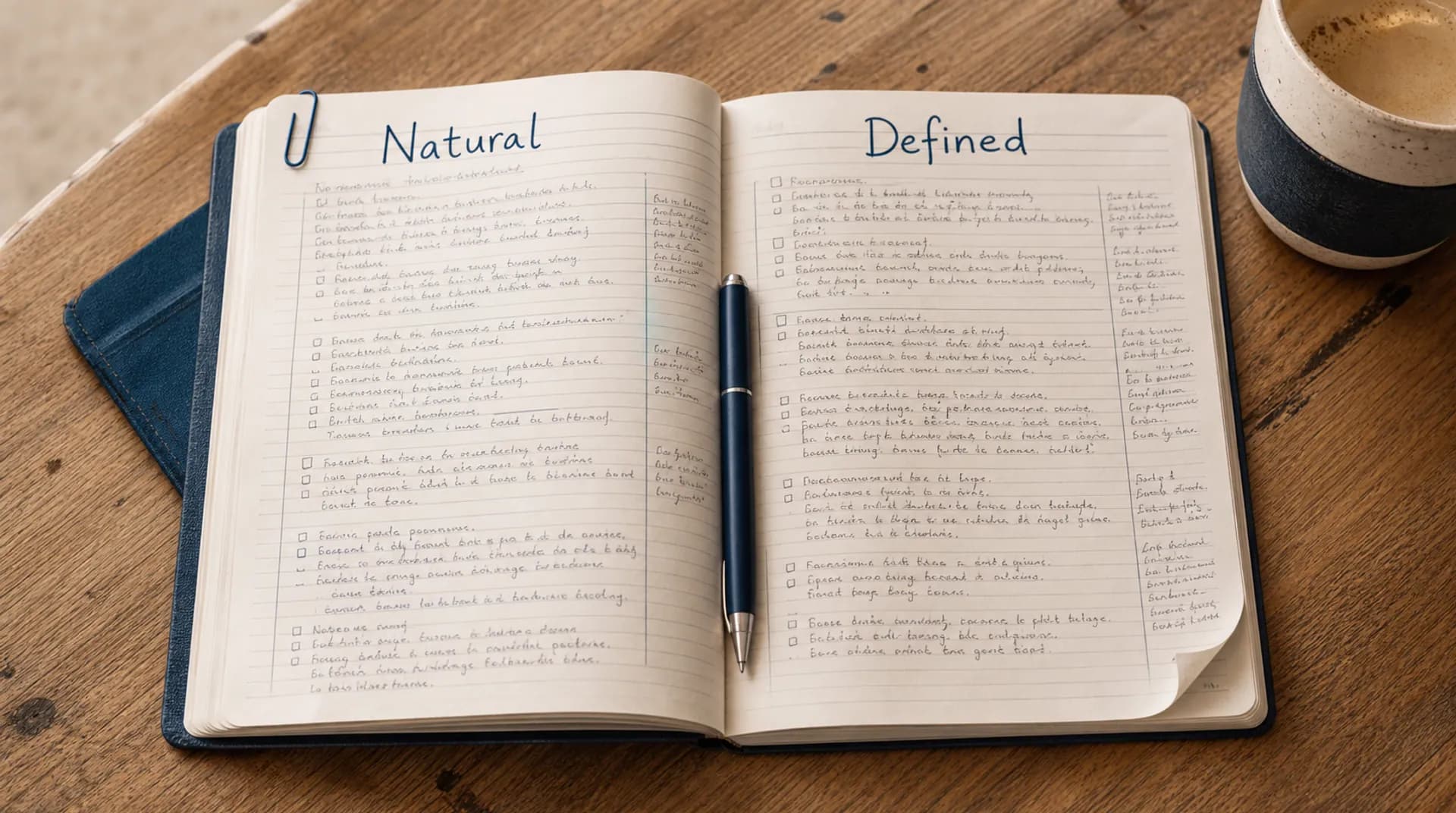
Photos help explain a preference, but they are not a contract
Reference photos can help you show a line, tip, or overall impression that is difficult to describe. Bring more than one view when possible and explain exactly what you are pointing to. Do not assume that the person in the photograph has the same anatomy, skin, cartilage, proportions, or breathing needs. A photo can start a conversation; it cannot prove that the same appearance can be reproduced for you.
Be cautious with heavily filtered images, changing camera angles, and before-and-after photographs without a clear context. A single image can make a small angle change look like a different nose. Ask the surgeon what the photographs show, which views are clinically useful, and what cannot be inferred from them. The consultation questions guide can help you prepare that discussion.
Proportion and function stay in the conversation
A surgeon does not assess the nose in isolation. The consultation may include facial measurements, photographs, the bridge, tip, nostrils, skin and soft tissue, cartilage and bone, and breathing. The aim is not to force every face toward one template. It is to understand what the proposed change would do in different views and whether the nose remains functional.
Dr. Sara Arjang describes her surgical style in terms of a modern harmonic approach and proportion to each patient's facial features. That is a description of her practice, not a guarantee of a specific result. Her profile explains her role at Nikan and the evidence Aysara has on file. Read the Dr. Sara Arjang profile, then ask the treating surgeon to explain the plan for you rather than relying on a label.

Expectations are part of clinical readiness
Rhinoplasty changes a visible part of the face, and satisfaction is personal. A 2025 systematic review and meta-analysis reported overall improvements in satisfaction and quality of life, but it also found very high variation between studies and differences between countries. A 2026 systematic review describes motivation, psychological readiness, social context, and expectations as relevant to how a result is experienced. These findings support careful, individualised counselling. They do not predict your result or diagnose your mental health.
A good decision does not require you to be excited every day. It does require that your reason for surgery is your own, that you can tolerate uncertainty, that you understand risks and recovery, and that you can accept a surgeon saying no to a request that is not appropriate. If anxiety, pressure from another person, or a hoped-for life change is driving the decision, say so in consultation. Taking more time is a valid outcome.
Early healing can also make the nose look unfamiliar. Swelling and gradual change can affect how you judge the result, so do not treat the first photographs as a final answer. The recovery guide and swelling and final-result guide explain the general timeline without authorising any patient's activity or telling you when your result is final.
Questions for the treating surgeon
- When you hear me say natural or defined, which features do you think I mean, and what needs clarification?
- Which requested changes are realistic for my anatomy, and which are not?
- How will the plan consider breathing, facial movement, skin, cartilage, and different views?
- What would you advise me not to change, and why?
- What are the main risks, alternatives, and uncertainties for the plan you are proposing?
- How will we discuss recovery, follow-up, and the possibility that the appearance may not match my expectation?
The Oman-to-Iran coordination layer
If you travel from Oman, the result conversation is only one part of the decision. You also need to understand who assesses you, who takes consent, who gives discharge and aftercare instructions, how translation works, and who receives questions after you return. Nikan supplies English and Arabic translators for international patients. Dr. Arjang and Nikan provide the clinical care. Aysara coordinates the non-clinical journey and does not choose or promise an aesthetic result.
The rhinoplasty coordination page explains the current route, and the planning guide for travel from Oman helps you organise the wider journey. Ask the provider to put the clinical plan, follow-up route, and package responsibilities in writing before you commit to travel. Do not treat a discussion about a style word as a treatment recommendation or a booking decision.
You are allowed to leave the label behind
Natural and defined are useful only when they help two people understand one another. If they make the conversation vague, replace them with a sentence about a feature, a view, a function, and a limit. A qualified consultation may support proceeding, changing the request, waiting, or deciding not to have surgery. The purpose of the conversation is clarity, not choosing the most impressive word.
Sources
- American Society of Plastic Surgeons: rhinoplasty consultation (accessed 2026-09-01)
- American Society of Plastic Surgeons: rhinoplasty procedure steps (accessed 2026-09-01)
- American Society of Plastic Surgeons: rhinoplasty overview (accessed 2026-09-01)
- PubMed: evaluation of preoperative and postoperative patient satisfaction and quality of life in rhinoplasty, systematic review and meta-analysis (accessed 2026-09-01)
- PubMed: evaluation of patient satisfaction and quality of life in rhinoplasty, 2025 systematic review and meta-analysis (accessed 2026-09-06)
- PubMed: psychosocial factors surrounding aesthetic rhinoplasty, systematic review (accessed 2026-09-01)
- Aysara internal surgeon record: Dr. Sara Arjang and proportional surgical style
- Aysara internal provider record: Nikan international-patient translation and follow-up support
Related articles
Rhinoplasty
Rhinoplasty Consultation: Questions to Ask Before You Decide
A rhinoplasty consultation checklist covering candidacy, risks, consent, recovery, travel follow-up, and the itemized quote.

Rhinoplasty
How to Plan Rhinoplasty Travel from Oman: A Practical Guide
A rhinoplasty travel checklist from Oman to Iran covering case review, surgeon and hospital checks, quotes, travel documents, and follow-up.
Rhinoplasty
Rhinoplasty Goals, Photos, and Realistic Expectations
How to describe rhinoplasty goals, use consultation photos responsibly, protect your privacy, and set realistic expectations before deciding.
Need help planning a trip?
Start with a short message by phone, email, or WhatsApp. Do not send medical documents through the first-contact form.